Cart 0


Intercooler Upgrades for High-Power Turbo Porsches: Why Charge Cooling Matters
Porsche intercooler upgrades don’t get talked about nearly as much as turbos or fuelling, but they should. When a turbocharger compresses air, that air heats up a lot. Hot air is less dense than cool air, so it carries less oxygen per volume. Less oxygen means less fuel can burn efficiently, and less fuel burning means less power. On top of that, hotter charge air raises cylinder temperatures and pushes the engine closer to detonation on any fuel type.
The intercooler sits between the turbocharger and the engine intake and its job is straightforward: cool the compressed air before it enters the cylinders. The cooler and denser that air arrives, the more power the engine can safely make at a given boost level. On a stock car, the factory intercooler handles this well enough. On a modified car running more boost and generating more heat, that factory unit runs out of ability pretty quickly.
At ES Motors, we include intercooler specification in every turbo upgrade package we put together. Getting charge cooling right matters just as much as getting boost levels right, and the two need to work together properly.
Why the Factory Intercooler Runs Out of Ability
The factory intercooler on a Porsche 911 Turbo is a water-to-air unit. It uses engine coolant to pull heat out of the compressed charge air before it enters the intake manifold. At factory boost levels and with coolant temperatures in a normal range, it does this job well enough.
The issue on a modified car shows up in two ways. More boost means more compressed air, and more compressed air means a lot more heat to remove. The factory core doesn’t have the surface area to shed that extra heat efficiently. At the same time, under sustained hard use, the coolant feeding the intercooler heats up progressively. As coolant temperature climbs, the intercooler loses its ability to cool the charge, and intake air temperatures follow it up.
This is heat soak, and it’s a real problem. The intercooler absorbs heat faster than the cooling system removes it, and power drops the longer the car runs hard. On a stock car it’s barely noticeable. On a serious high-power build it becomes a major concern for both power output and engine safety, and it’s one of the main reasons people look at Porsche intercooler upgrades in the first place.
Upgraded Water-to-Air Intercooler Cores
The most common Porsche intercooler upgrade for 911 Turbo builds is a larger water-to-air core. These units sit in the factory intercooler location but use a bigger, denser core with more internal surface area. More surface area means more heat transfer, which means cooler air reaching the intake manifold.
A larger core handles more heat load before it saturates. That directly reduces intake air temperatures under sustained boost, keeps charge density higher, and reduces detonation risk. On a properly matched upgrade the temperature improvement is meaningful, and cooler intake temperatures translate into safer tuning headroom and more consistent power from run to run.
Core construction matters too. High quality bar-and-plate cores maximise internal turbulence and heat transfer efficiency in a way that cheaper tube-and-fin alternatives can’t match. At ES Motors, we pick intercooler cores based on the actual flow requirements of the turbo setup and the power target of the build, not just on what physically fits.
Ice Tank and Chiller Systems for Maximum Cooling
On builds chasing the highest power numbers or running drag and roll racing events, an upgraded core on its own sometimes isn’t enough. In those cases an ice tank or chiller system adds a level of charge cooling that a standard water-to-air setup simply can’t deliver.
An ice tank routes intercooler coolant through a reservoir packed with ice before it reaches the core. Ice absorbs heat extremely quickly and drops coolant temperature to near zero, which pulls intake air temperatures down significantly. This works best over short repeated runs, so it suits drag strip and roll racing use well.
Chiller systems work differently. They use a refrigeration circuit to continuously cool the intercooler coolant rather than relying on ice that depletes and loses effectiveness over time. That makes them better suited to track driving, where the car needs consistent cooling performance across multiple laps rather than just for a short burst. At ES Motors, we match the cooling approach to how the car actually gets used.
Charge Pipes and Intercooler Ducting
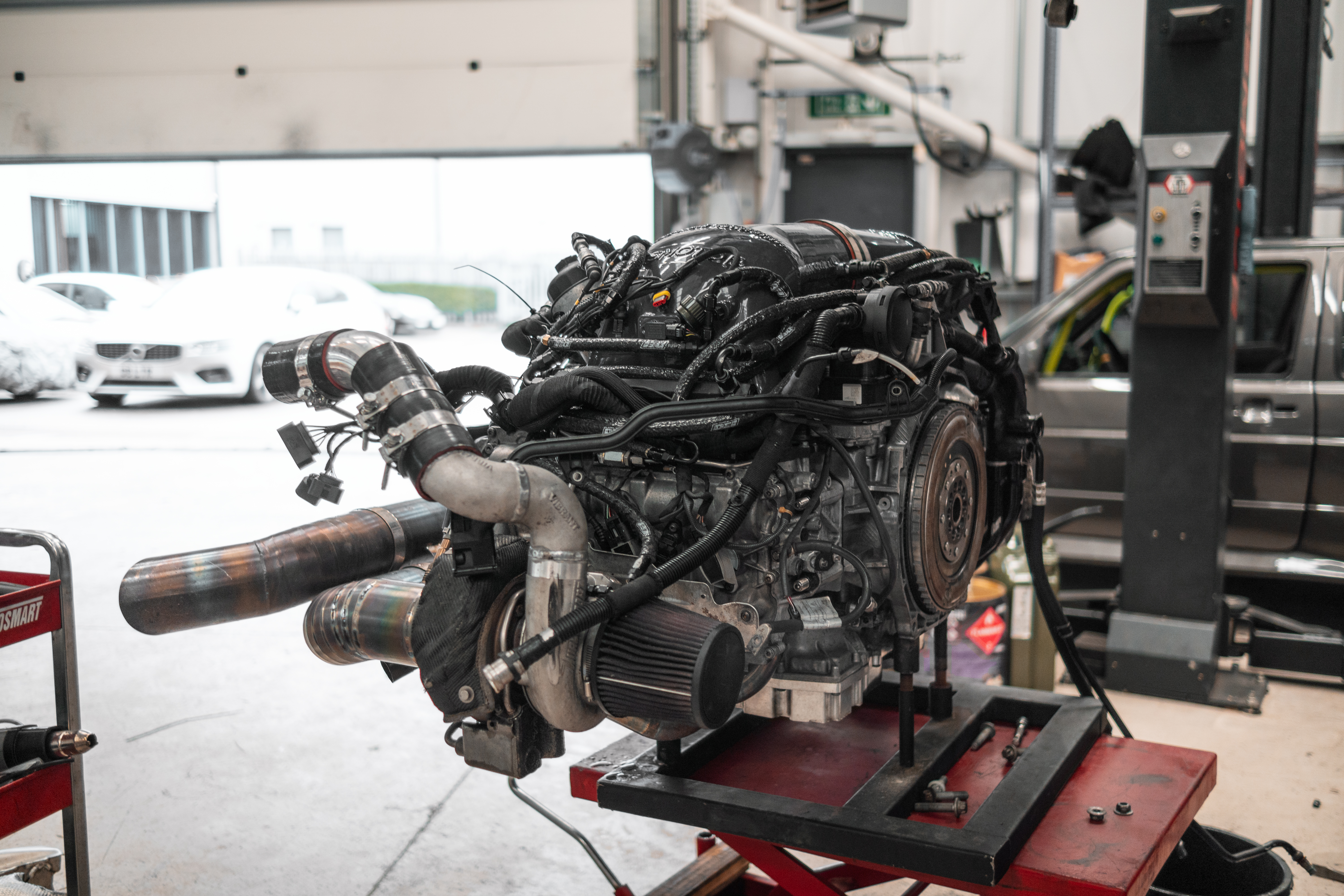
The intercooler core is only part of the story. The pipes connecting the turbos to the intercooler and the intercooler to the intake manifold also affect charge temperature and boost delivery. Factory charge pipes are sized around factory airflow. On a high-power build moving considerably more air, undersized pipes create pressure drop and turbulence that costs boost and adds heat before the air even reaches the engine.
Larger diameter charge pipes with smoother internal surfaces reduce pressure drop through the system. Less pressure drop means more of the boost the turbos generate actually makes it to the cylinders rather than being wasted as friction and heat in the pipework.
Silicone couplings and solid clamps at every joint keep boost leaks from becoming a problem. A small leak on a low-boost car is barely noticeable. On a car running 30 PSI or more, even a minor leak shows up quickly as inconsistent boost and poor throttle response. At ES Motors, we treat the full charge pipe system as part of the intercooler upgrade, not a separate job.
How Intercooler Upgrades Change the Tune
A larger intercooler changes the intake air temperature the engine sees, and that directly affects how the tune needs to be written. Cooler charge air resists detonation better, so the tuner can run more ignition advance safely. That extra timing adds power on top of what the intercooler delivers through better charge density alone.
This only works if the tune actually reflects the new hardware. A map written for the factory intercooler on a car with an upgraded unit leaves timing and power on the table. Running an aggressive map written for an upgraded intercooler on a car where that intercooler has heat-soaked puts the engine at risk. The intercooler and the tune have to match, which is why at ES Motors we handle both together as part of the same process.
Data logging intake air temperatures before and after an intercooler upgrade gives a clear picture of the improvement and gives the tuner what they need to get the map right around the new hardware.
Porsche Intercooler Upgrades at ES Motors
Every turbo build we put together at ES Motors includes a charge cooling assessment. We match the intercooler spec to the turbo setup, the power target, and how the car gets driven. A street car on upgraded VTG turbos needs a completely different intercooler approach to a ball bearing turbo car built for half-mile racing.
We handle the full charge pipe system, coolant routing, and ECU tune integration as a complete package. Porsche intercooler upgrades done on their own without looking at the surrounding system rarely deliver everything they’re capable of. Done properly as part of a complete build, the improvement in power consistency and engine protection is hard to ignore.
Related at ESMotor: see our Porsche 992 Turbo S tuning packages.
If you’re planning a turbo upgrade and want charge cooling that actually keeps up with your power target, contact ES Motors and speak with our build specialists today.